

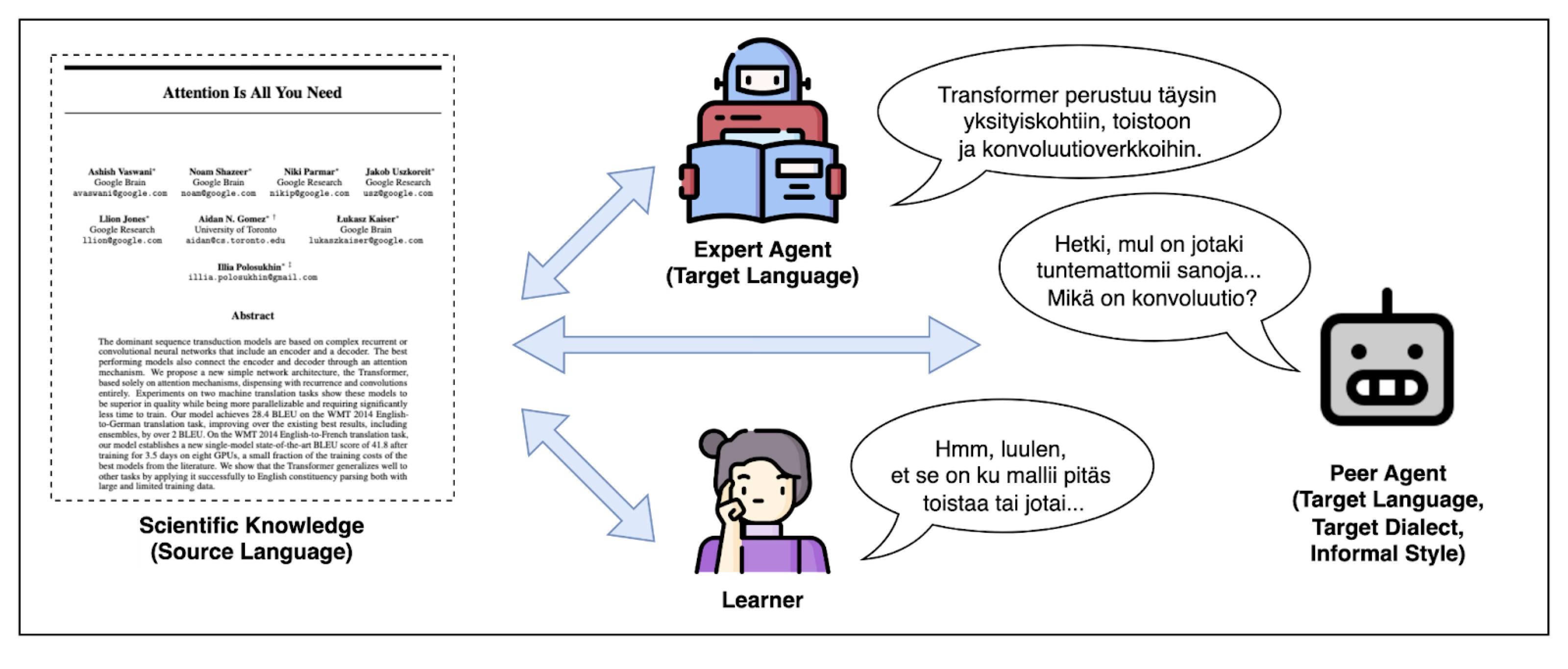
A major barrier to disseminating and democratising scientific advances is access to languages that dominate scientific content but also the mismatch between the formal language of scientists and the everyday expressions understood by the general public. In this project we aim to translate science, not just across language but across language style, not just to the written form but to an engaging spoken form.
We have made enormous advances in machine translation (MT), and recent advances in Large Language Models (LLMs) have shown a mastery of text we could not have envisaged ten years ago. Speech technology has also improved to the point where voices sound natural and recognition is robust. The current challenge for the research community is to integrate these technologies with other innovative techniques and research to produce engaging and compelling use cases. In this project, we regard a text translation of science material as a starting point. Our challenge is reframing this material into speech and an engaging dialog, producing a multilingual solution which can translate science into the everyday, to generate language that can be spoken, language that can be entertaining. Fictive dialogs are an approach where an idea is communicated by turning it into an accurate dialog focused on that idea. Previous work has shown that dialogs can communicate information more effectively and be more persuasive. We aim to generate interactive fictive dialogue across multiple multi-lingual science texts, in order to make a concrete contribution to educational services, as well as to increase involvement and passion from groups who may be marginalised by background or less mainstream native languages. Just as Plato used fictive dialogs to bring to life the work and philosophy of Socrates, we aim to bring modern science to life for citizens, undergraduates and postgraduates across Europe.
The ARTICULATE project is in collaboration with UCD Dublin and The University of Oulu Finland.