

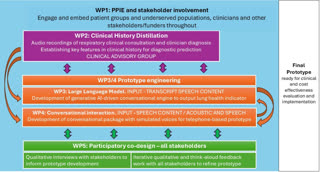
The overarching aim for our programme of work is to support people with undetected respiratory disease to seek appropriate healthcare earlier; in line with three of the top 10 joint patient and clinician research priorities for breathlessness. The Artificial Intelligence assisted earlier Respiratory Evaluation (AIRE) prototype will enable people concerned about their breathing to access an ‘AI respiratory specialist’ in their own environment.
Essentially, end-users will call a phoneline for an AI-powered telephone-based respiratory specialist assessment. AIRE will replicate conversational clinical history taking for respiratory symptoms, embed audio and speech cues, to deliver a clear outcome of lung health via a traffic light indicator to encourage people to seek healthcare where indicated. This grant will work with end-users to co-create a functional AIRE prototype ready for real-world evaluation. By leveraging inter-disciplinary approaches to combine advanced engineering and physical sciences (EPS), conversational AI, and respiratory medicine, AIRE will deliver an intelligent, inclusive and accessible low-cost solution that uses the familiarity of a landline phone to accelerate the early detection of respiratory conditions.
Clinical Team Leads
PI University of Leicester: Prof Rachael Evans is an expert in the diagnosis and treatment of respiratory distress. She is Professor of Respiratory Medicine at the University of Leicester and Honorary Consultant Respiratory Physician. Clinically, RE leads a diagnosticintegrated breathlessness service, the largest UK Long Covid service, and an advanced COPD service. Her NIHR-funded research including a clinician scientist fellowship investigates early diagnosis and treatments for chronic breathlessness.
University of Oxford: Dr Helen Ashdown, an NIHR Academic Clinical Lecturer in Primary Care in the Infection, Respiratory and Acute Care (IRAC) Group at the Nuffield Department of Primary Care Health Sciences, University of Oxford, will ensure that our innovative technology is designed for community health settings. HA is a GP with a clinical and research interest in lung disease, and leads a number of mixed-methods research programmes across chronic respiratory disease and undifferentiated breathlessness, aimed at evaluating novel health technologies in community settings.
University of Sussex: Simon Waddell, Department of Global Health and Infection at Brighton and Sussex Medical School, University of Sussex, He is Director of the Centre of Infection and Antimicrobial Research (CINAMR) with a focus on tackling health inequalities and reaching underserved groups in coastal communities. Simon will work with patient groups and stakeholders to ensure co-design and public engagement is at the heart of AIRE.
Technical Team Leads
University of Leeds: AIRE’s novel speech technology will be built using the expertise of Dr Maryam Hafeez, Associate Professor in Communication Networks and Systems, School of Electronic and Electrical Engineering, University of Leeds. MH has extensive expertise in large language models, specifically in spatio-temporal modelling of large-scale networks for communication and networking protocols.
Heriot-Watt University: Dr Matthew Aylett is an Associate Professor in Applied AI in the School of Mathematical and Computer Science at Heriot-Watt University. He is an expert in speech technology and embodied conversational systems. His Royal Society-funded research was selected as a case study of academic, social and commercial synergy. He has made significant contributions to large consortia funded by both EU and EPSRC.